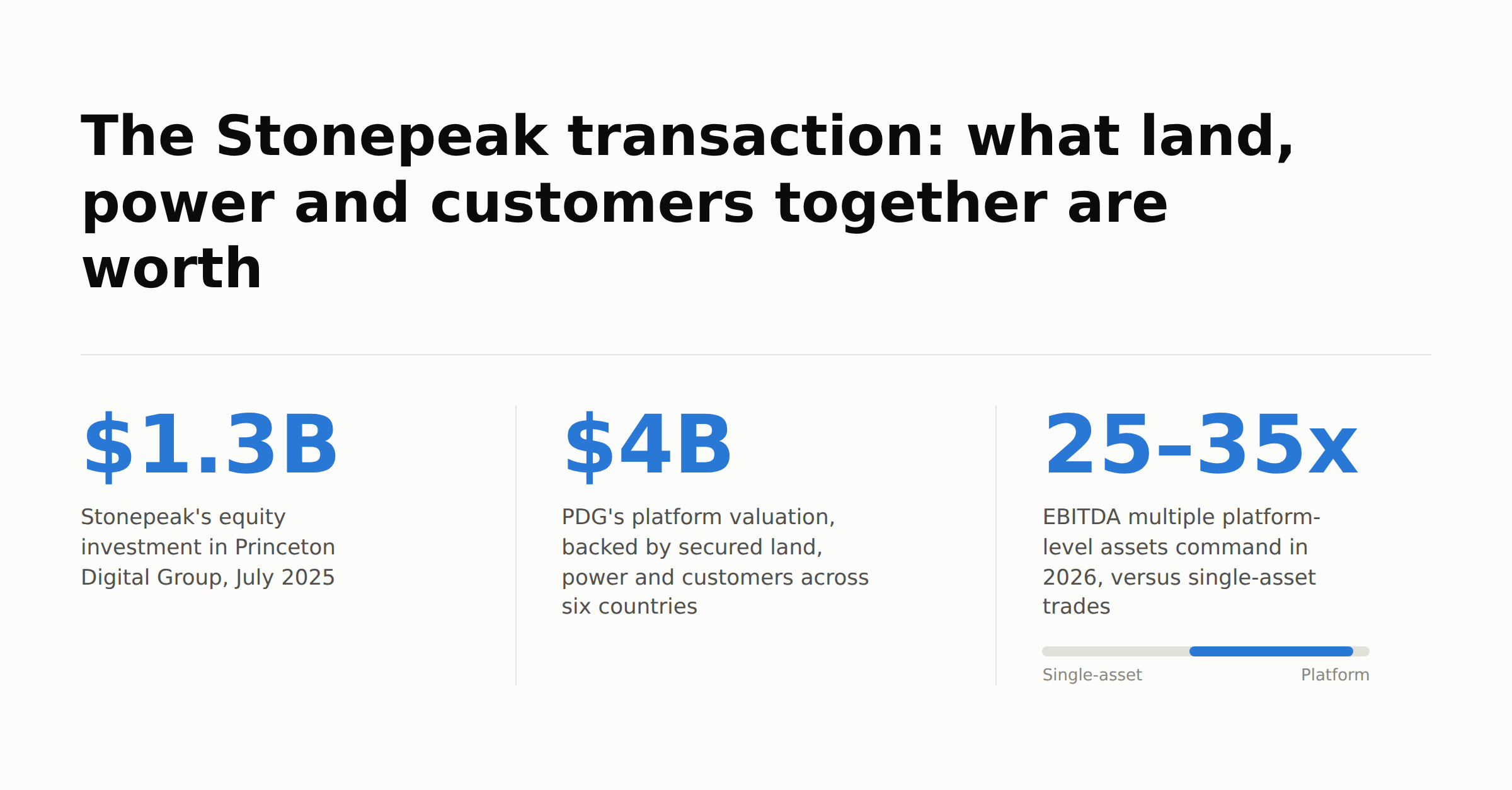
- Platform-level data centre assets, those with secured land, power and customers bundled together, are commanding 25-35x EBITDA in Southeast Asia, a material step-up on single-asset trades.
- Stonepeak’s US$1.3 billion investment in Princeton Digital Group, at a US$4 billion valuation in July 2025, was underwritten by PDG’s “power bank” across six countries, not by any single building.
- Australia’s own net-generator mandate, announced 15 July 2026, lands in a market where most local AI workloads still run on three US hyperscalers. The platform logic driving Asian dealmaking is now Australia’s operating reality too.
ARC Group’s Southeast Asia Data Centre M&A 2026 report makes a clear argument. As power, water and land become the binding constraints on new supply, the assets attracting the highest multiples aren’t the biggest single facilities. They’re the platforms that have already locked in the full combination, land, power, water and a diversified customer base, and can repeat that delivery across markets.
The platform premium is not about the building
PDG operates 1.1GW across Singapore, Japan, India, Indonesia, China and Malaysia. What made Stonepeak’s cheque a platform-level bet rather than a property trade was PDG’s “significant power bank in critical hub markets,” the combination of secured land, approved power and existing customer relationships that lets it keep building without starting each site from zero. It also holds OCP Ready v2 for Hyperscale certification across multiple APAC countries, letting hyperscalers fast-track deployment at pre-qualified sites. Stonepeak’s own portfolio logic backs this up. This was its third data centre investment in Asia Pacific and its ninth globally. That’s not opportunism. It’s a deliberate bet that the scarcest asset in this market is a repeatable pipeline, not a lease.
Sovereignty has become a deal term, not a policy slogan
Malaysia’s 2026 budget put roughly US$490 million into a sovereign AI cloud, part of a broader US$1.44 billion AI commitment aimed at keeping data and model training within its borders. ASEAN’s Trusted Data Corridors framework, endorsed in January 2026, goes further. It lets accredited data centres exchange data freely within the bloc while keeping it outside the reach of non-member jurisdictions. Singapore and Malaysia are building toward the same outcome from opposite ends: data has to move fast, but it has to stay onshore or in-region to count as trusted.
Australia is earlier in that cycle but the pressure is the same. Most Australian businesses running AI workloads today are running them on infrastructure controlled by AWS, Microsoft Azure or Google Cloud, which brings CLOUD Act exposure into conflict with obligations under the Privacy Act 1988, the SOCI Act and APRA’s CPS 230. Commonwealth and state agencies are already running data sovereignty assessments through the National AI Centre as part of procurement. The direction of travel is the same one Malaysia and Singapore are already several years into.
Australia just supplied its own reason for the platform play to matter
In July, the Albanese government moved to require new large-scale data centres to become net energy generators rather than net users, funding renewable and firming capacity at least equal to what they draw from the grid and covering their own grid connection costs. National Cabinet sign-off was sought in August, with legislation targeted for early 2027. The scale of demand behind this is not trivial. Data centre electricity use is forecast to grow from 3TWh to 30TWh by 2035, and a single hyperscaler’s flagged investment could imply up to 20GW of new demand, close to 60% of Australia’s current annual generation.
Under a net-generator regime, the developers who win won’t be the ones with a shovel-ready site. They’ll be the ones who’ve already bundled land, power and water together and can prove it to both the regulator and the customer, exactly PDG’s and STT GDC’s playbook in Asia.
The trends in ARC’s report aren’t a Southeast Asia story anymore. Mandatory energy self-sufficiency and a maturing data sovereignty requirement across government and regulated industries mean the platform developers who’ve secured land, power, water and committed customers together are the ones positioned to capture this cycle, not the ones still queuing for a grid connection.
The question worth asking about Australia’s data centre boom isn’t whether the demand shows up. It clearly will. It’s which platforms have actually secured the power and land position before the standard is locked in.
#DataCentres #EnergyTransition #DataSovereignty #DigitalInfrastructure #Infrastructure
References
- ARC Group, “Southeast Asia Data Centre M&A in 2026,” arc-group.com, 2026.
- Stonepeak, “Stonepeak Completes USD 1.3 Billion Investment in Princeton Digital Group,” stonepeak.com, 2025.
- PV Tech, “Australia to legally require large data centres to become net-generators of renewable energy,” pv-tech.org, July 2026.
- Amaze, “Why Australia needs sovereign AI infrastructure,” amaze.au, 2026.
Leave a Reply