I’m having a lot of conversations right now with companies in the energy transition space about their current commercial priorities, and increasingly they trace back to the same short to medium term goal: raising development capital.
That goal is landing in a tougher market than many expect. Australia’s top 30 super funds have deployed just $771 million, 0.8% of the $99 billion invested in renewable energy projects since 2020, despite sitting on $4.5 trillion in retirement savings. 77% of investors say the local environment has gotten harder over the past year.
In a market this selective, the biggest risk to an early stage energy transition raise isn’t capital scarcity. It’s launching the process before readiness has been tested by anyone other than the people who built the deal.
Founders and boards almost always assess their own readiness. They know the technology, believe the strategy, and have lived with the commercials long enough to stop seeing the gaps. Investors test all of it independently, in parallel, in the first few weeks of diligence, and it only takes one weak dimension to stall the whole raise. By the time that surfaces, you haven’t just lost time. You’ve burned the specific investors who would have backed you if you’d approached them properly prepared.
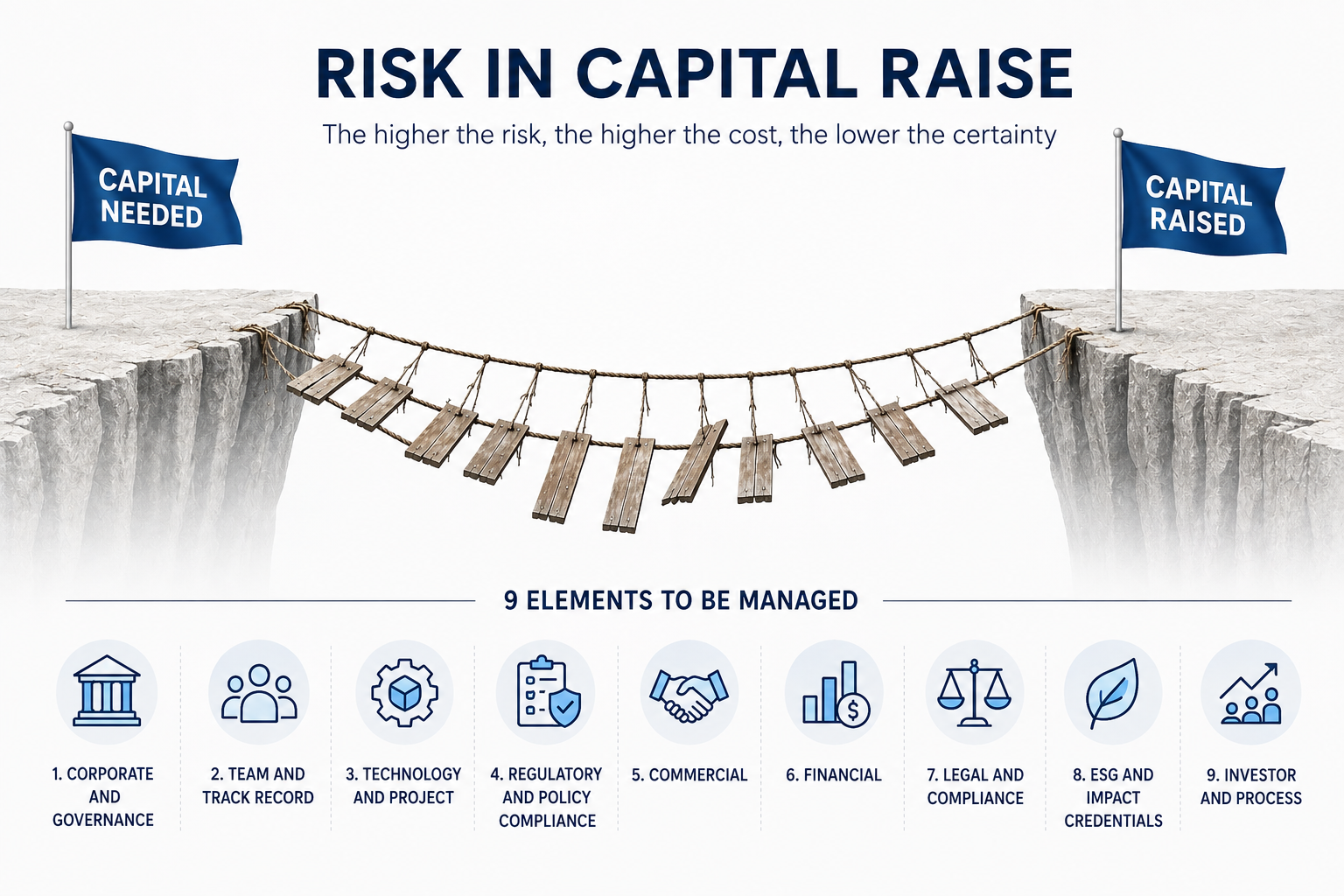
A raise readiness audit, run before you go to market rather than discovered during it, starts with understanding what investors actually test, and why.
Corporate and governance readiness. The entity structure, decision making authority and board composition behind the project. Tested because it tells an investor who they’re really negotiating with, and whether decisions can be made fast enough to close.
Team and track record. The delivery history of the people running the project. Tested because investors are underwriting the team’s ability to execute as much as the asset itself.
Technology and project readiness. Engineering design progressed to a level that supports the numbers in the model. Tested because unresolved technical questions undermine every other assumption in the case.
Regulatory and policy compliance. Approvals, permits and licences secured or on a credible, evidenced path. Tested because policy risk gets priced directly into the return an investor requires.
Commercial readiness. Offtake, distribution, sales or representation agreements, supplier agreements, and pricing tested against the market rather than modelled in isolation. Tested because this is what turns a forecast into a contracted, financeable revenue line.
Financial readiness. A balance sheet that can support the structure being proposed, and a strategy that explains specifically how the investment generates a return. Tested because it shows whether the raise is solving the right problem.
Legal and compliance readiness. Contracts, IP and obligations documented cleanly. Tested because anything surfaced for the first time during diligence reads as risk, whether or not it actually is.
ESG and impact credentials. Substantiated with evidence, not asserted. Tested because a growing share of capital screens on this before it looks at anything else.
Investor and process readiness. Clarity on what type of investor the strategy actually needs, a shortlist built around that, and documentation that can withstand real scrutiny. Tested because a strong project taken to the wrong investors still fails.
What I often find when reviewing a capital raise approach is gaps. Commercial agreements further from execution than assumed, technical or regulatory items still open, or governance and documentation that would not survive real scrutiny. Surfacing these early means they get fixed quietly, on your own timeline, instead of live in front of the investors you are trying to win. That difference is what saves time, protects reputation, and avoids the cost of a stalled or restarted process.
Skip any of these elements and the chance of successfully closing the raise drops sharply, not just the timeline. Investors don’t lower their bar for an underprepared raise. They walk, mark the valuation down, or quietly stop returning calls, and in a market this small, word travels fast.
If you’re planning a raise and want an independent read on where the real gap sits before you go to market, I’d welcome a conversation.
#EnergyTransition #CapitalRaising #ProjectFinance #CleanEnergy #InvestmentReadiness
Leave a Reply